
Whoa whoa whoa – listen to the music! It’s all in the rhythm of the music. Understanding that the English language is like the rhythm in music will greatly improve your pronunciation. Are you ready to do it correctly?
Languages are like music, and like a song. Music and songs include rhythm just like languages. And, the English language is no different, except the rhythm of spoken English is so important to sound better when speaking English.
Okay, here is the strategy:
English is a stress-timed language, and we produce sentences with rhythm, where we swallow weak sounds and weak ‘words’ (such as the following parts of speech: articles, pronouns, conjunctions auxiliaries and prepositions) linking together certain phonemes to make our message more meaningful.
This is in sharp contrast to a syllable-timed language (e.g. Spanish, Italian, Japanese, French) that stress every syllable producing a mechanical and sometimes staccato type delivery.
See the illustration below to help visualize the difference between syllable-timed language versus English-timed language:
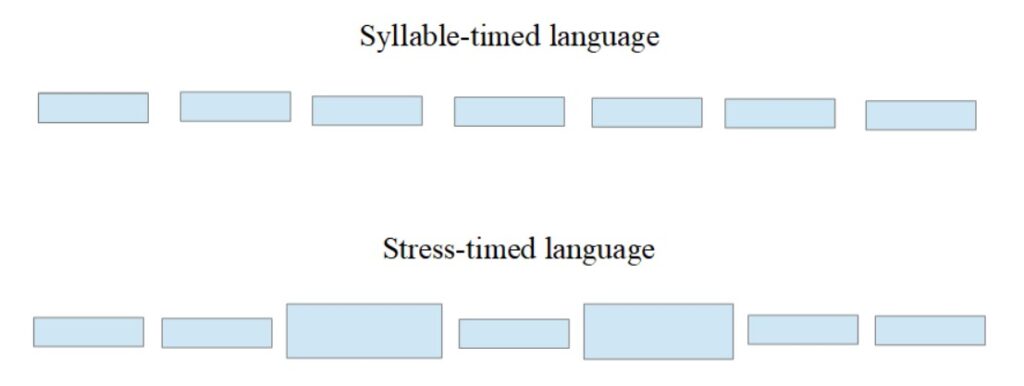
The use of stress timing and elision to aid meaning is a positive phonological feature.
What is the meaning of “elision”?
– the omission or deletion of one or more sounds (such as a vowel, a consonant, or a whole syllable) in a word or phrase. For example: fish ‘n chips (sounds more English than “fish and chips”).
What are “phonemes”?
– phonemes are basically a sound; it’s the smallest unit of sound in the English language. For example: the element ‘p’ in the word “tap”.
If you need more information about this topic, or you need help in general, please do not hesitate and contact us!